

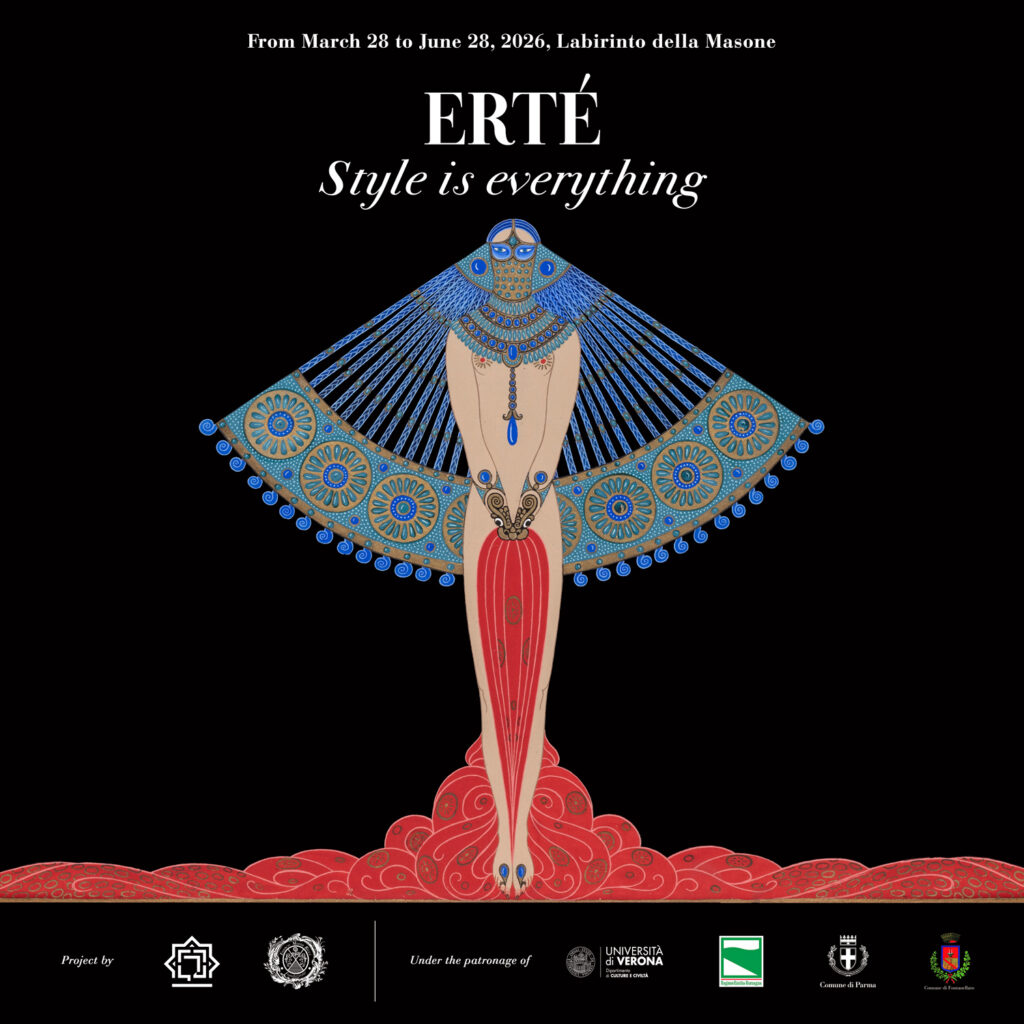
ERTÉ
Style is Everything
March 28 - June 28, 2026
Curated by Valerio Terraroli
The new spring exhibition at the Labirinto della Masone is dedicated to Erté, one of the most emblematic figures of the Art Déco movement.
A scenographer, costume designer and visual artist among the most versatile and visionary of the twentieth century, Erté forged an unmistakable language blending the decorative and symbolic elements of interwar modernity.
His drawings – defined by sophisticated geometries and impossible elegance – recount the changing styles and the unreachable world of divas, while revealing the dialogue between haute couture and mass culture.
A fixture in major public and private collections worldwide, Erté is here the focus of an exhibition collecting more than one hundred and fifty works, many of them never displayed before, offering a wide and unprecedented perspective on the variety and richness of his creative universe.
Having arrived in Paris from Russia in 1912, Erté – born Roman Petrovič Tyrtov and later French-styled Romain de Tirtoff – began working at a very young age for Paul Poiret, the couturier who revolutionised early-twentieth-century fashion.
From 1915 to 1937, he collaborated with Harper’s Bazaar, creating over two hundred covers for the magazine. Through this long partnership, which played a decisive role in shaping the visual imagery of Art Déco, he established himself as an internationally renowned illustrator.
His works also appeared in Vogue, Cosmopolitan, and The London News, consolidating his fame on both sides of the Atlantic.
At the same time, Erté designed costumes for Music hall and for the major theatrical productions enlivening Paris and New York in the 1920s, eventually extending his work to Hollywood. From Mistinguett to Marion Davies, from Sarah Bernhardt to Mata Hari, Erté’s creations turned the ordinary into the extraordinary.
His stage designs for the Folies-Bergère and the Ziegfeld Follies became true ‘wonderlands’, enhanced by memorable inventions such as ‘living curtains’ and ‘collective costumes’.
It is little wonder that his designs achieved such resonance. Innovative, elegant and extravagant, they became icons of a dazzling Déco aesthetic – one profoundly attuned to the world of Franco Maria Ricci.
It was indeed Ricci who, in 1970, published the first major Italian volume dedicated to Erté, featuring an essay by Roland Barthes, as part of the series The Signs of Man. On that occasion, several of the artist’s works entered the collection now preserved at the Labirinto della Masone, recently enriched by the acquisition of four additional drawings by the Russian master.
At a time of renewed critical and curatorial attention to Art Déco, the exhibition offers a comprehensive re-reading of Erté’s oeuvre, revealing its complexity and modernity.
The exhibition brings together over one hundred and fifty works – drawings, sketches (including pieces from the Victoria and Albert Museum in London), pochoirs, lithographs, photographs, documents and film materials – with particular focus on the 1910s, 1920s and 1930s, the most original and fertile period of his career.
Alongside loans from Italian and international private collections, the exhibition also features the twenty-eight works belonging to the Franco Maria Ricci Collection.
The impactful exhibition design guides visitors through Erté’s visual universe by exploring the principal domains of his activity: from fashion illustration to theatre and Music hall, from editorial collaborations to his celebrated Alphabet and Numbers series.
The exhibition was curated by Valerio Terraroli, coordinated by Elisa Rizzardi and designed by Maddalena Casalis.
For the occasion, a namesake volume will be published by Franco Maria Ricci Editore, featuring texts by Valerio Terraroli and Alessandra Tiddia.